No Products in the Cart
Avail 10% Off, Use Code - ADVITYA10 + Get Extra 5% on Prepaid Orders

(The Spiritual Science, Mythology & Symbolism Hidden in Every Krishna Idol)
The divine image of Krishna is incomplete without the graceful peacock feather adorning his crown. Whether you see a Krishna idol, a temple Krishna statue, or a beautifully carved Krishna murti at home, the feather instantly catches the eye. It is delicate yet powerful, simple yet deeply symbolic, a reminder that every part of Krishna’s form is filled with philosophy and timeless meaning.
But what does the peacock feather truly signify? Why is it considered so important that no traditional artist ever sculpts a Lord Krishna idol without it?
This blog explores the hidden layers of symbolism behind the mor-pankh (peacock plume), drawing from mythology, aesthetics, environmental wisdom, and devotional tradition.
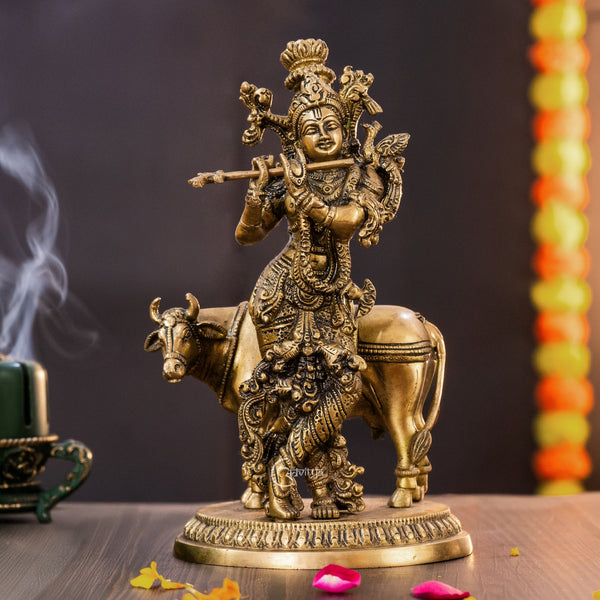
The peacock is one of the most celebrated creatures in Hindu mythology. According to ancient stories:
During Krishna’s childhood in Vrindavan, he would often play his flute in the forests. When he played, the peacocks danced ecstatically around him. Their dance was so full of devotion and joy that the king of the peacocks bowed down and offered his most precious feather at Krishna’s feet.
Krishna accepted it with love and placed it on his crown, symbolizing the highest honor the natural world could offer him.
In the Bhagavata Purana, peacocks are described as symbols of sattva, the quality of purity and divine harmony. By wearing the feather, Krishna shows:
mastery over senses
control over ego
the ability to remain joyful and pure despite worldly chaos
The mor-pankh symbolizes nature bowing in reverence to the Supreme Being. This is why almost every Krishna murti crafted for home décor includes this feather, it reminds devotees that: Nature flourishes where divinity resides.
The peacock feather is a miniature universe of spiritual meanings. Here are the deeper layers:
The unique eye-like shape at the center of a peacock feather is symbolic of:
Krishna’s all-seeing awareness
Protection from negativity
Wisdom that sees beyond illusion (Maya)
This is why many devotees keep a peacock feather inside the home temple alongside their Lord Krishna Idols
The feather blends vibrant blue, green, brown, and golden tones. Each color reflects a cosmic element:
Blue — Infinity & truth (Krishna’s cosmic form)
Green — Growth, fertility, harmony
Brown — Stability & grounding energy
Gold — Prosperity & divine light
When a Krishna idol wears these colors, it represents the perfect balance between earth and sky, material and spiritual, body and soul.
Krishna, the protector of dharma, wears no jewels on his crown during childhood, only a simple feather.
It teaches:
True divinity never needs adornment; it shines through simplicity. A Krishna statue with a peacock feather reminds us that humility is the greatest ornament.
Across scriptures and folklore, Krishna’s feather carries timeless teachings:
Just like a feather, Krishna’s presence teaches us to live without unnecessary burdens.
The variety of the feathers reflects Krishna’s message of embracing joy, playfulness, and love.
The feather is naturally satvik and represents a pure mind and heart.
By choosing a natural element over gold, Krishna teaches ecological awareness much ahead of time. This is why families love placing a Krishna murti with a peacock feather in their living room, pooja room, or entryway to invite balance, beauty, and devotion.
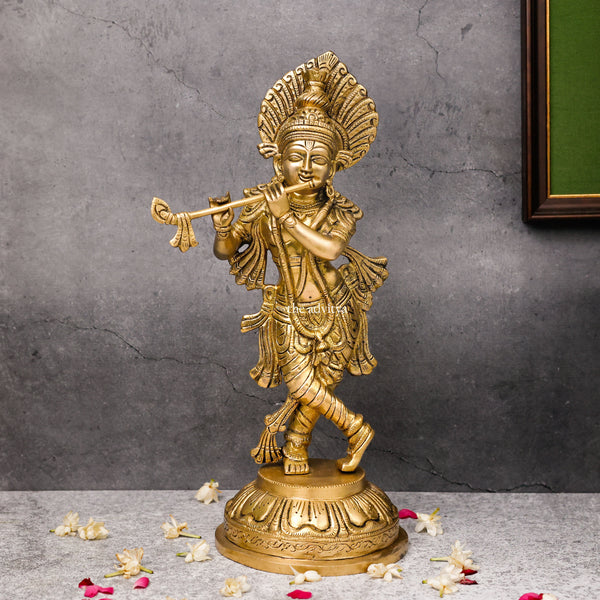
Artists and artisans across centuries make sure the feather is always present because:
It completes Krishna’s identity as Natkhat Nandlal
It reminds devotees of Vrindavan’s beauty
It represents the innocence of divine play (Leela)
It is a symbol of cosmic protection and auspiciousness
From brass to marble, resin, wood, and handcrafted metal, every Krishna statue carries this sacred element as a signature of divinity.
According to Vastu:
✔ A Krishna idol with a feather attracts happiness and harmony
✔ Helps reduce conflicts and brings peace to the household
✔ Enhances creativity, especially for children
✔ Invites prosperity, abundance, and positivity
Ideal directions:
North-East, East, or North for maximum auspicious energy.
The peacock feather on Krishna’s crown is not a decoration; it is scripture, symbolism, story, and spirituality woven into one enchanting form. Every time you place a Krishna idol or admire a beautifully crafted Krishna murti, remember that the feather represents:
nature’s devotion
divine vision
humility
cosmic balance
joy
protection
It is Krishna’s gentle way of whispering to his devotees - “Live beautifully. Live lightly. Live with love.”
